

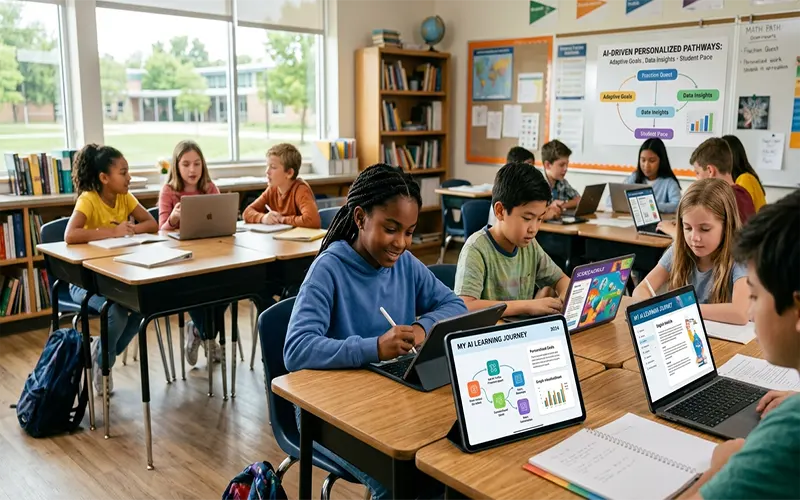
For decades, the “factory model” of education—characterized by a one-size-fits-all curriculum and synchronized pacing—has been the standard in K-12 classrooms. However, as we move through 2026, a fundamental shift is occurring. Artificial Intelligence (AI) is no longer a futuristic concept or a supplementary tool; it has become the architectural foundation for a new era of “one-size-fits-one” education. By leveraging AI-driven personalized learning pathways, schools are finally bridging the gap between theoretical pedagogy and the diverse, real-time needs of every student.
The Mechanics of Personalization: Beyond the Linear Curriculum
At its core, an AI-driven personalized learning pathway is a dynamic educational map that evolves as a student interacts with it. Unlike traditional digital textbooks that offer a linear progression, these systems utilize sophisticated machine learning algorithms and predictive analytics to analyze student behavior in real-time.
These platforms operate within what psychologists call the Zone of Proximal Development (ZPD)—the “sweet spot” where a task is challenging enough to encourage growth but not so difficult that it causes frustration. As a student works through a module, the AI monitors data points such as:
- Assessment Accuracy: Correct and incorrect responses to formative checks.
- Engagement Time: How long a student dwells on a specific concept or video.
- Learning Style Affinity: Whether a student performs better with visual simulations, text-based explanations, or interactive gamified elements.
When the system detects a misconception, it doesn’t just provide the right answer; it pivots. It might offer an alternative explanation, scaffold the problem into smaller steps, or surface a prerequisite lesson the student may have missed. Recent research published in early 2026 indicates that students utilizing these adaptive pathways see a mean 11.7% improvement in performance and a 6.3% increase in course completion rates compared to conventional methods.
Empowering Diverse Learners: Equity through Technology
The most transformative impact of AI-driven pathways lies in their ability to support students who have traditionally been underserved by standardized models.
- Special Education: For students with neurodivergent profiles, AI can adjust the sensory load of content, provide automated speech-to-text, or offer repeated, non-judgmental practice that builds confidence.
- English Language Learners (ELL): Multimodal AI now provides real-time translation and vocabulary support within the flow of a science or history lesson, allowing students to master core subjects while simultaneously building language proficiency.
- Gifted and Talented: Rather than waiting for the rest of the class to catch up, high-achieving students can follow “accelerated tracks” that dive deeper into complex applications, preventing disengagement and fostering a true love of inquiry.
By addressing individual needs at scale, AI serves as a “leveling tool” that promotes educational equity, ensuring that a student’s zip code or learning disability does not dictate their academic ceiling.
The Teacher’s Evolution: From Lecturer to Mentor
A common misconception is that AI-driven pathways aim to replace the teacher. In reality, the most successful implementations in 2026 show that AI acts as the teacher’s most powerful partner. By automating the “mechanical” aspects of teaching—such as grading, basic data collection, and initial content delivery—AI frees up an average of five to ten hours per week for educators.
This time is being reinvested into high-value human interactions. Teachers are shifting from being the “sage on the stage” to the “guide on the side.” With real-time dashboards that highlight exactly which students are struggling and why, teachers can conduct targeted small-group interventions or provide one-on-one mentorship. The human connection remains the heart of education; AI simply provides the data and the time to make that connection more impactful.
Ethical Guardrails: Privacy and the “Black Box”
The rapid adoption of AI in K-12 also brings significant responsibility. Data privacy is the paramount concern in 2026, as these systems require vast amounts of sensitive student data to function effectively. Schools must navigate strict frameworks like FERPA and GDPR, ensuring “data minimization”—only collecting what is strictly necessary and ensuring that student data is never used for secondary commercial purposes.
Furthermore, there is the challenge of algorithmic bias. If an AI is trained on historical data that reflects societal prejudices, it could inadvertently steer certain demographics toward lower-level pathways. Ensuring transparency and “explainability”—where educators can understand and override AI recommendations—is essential to maintaining trust and fairness in the system.
The Path Forward: 2026 and Beyond
As we look toward the remainder of the decade, the trend is moving away from generic chatbots toward purpose-built educational platforms. We are seeing the rise of multimodal AI tutors that can see a student’s handwritten work via camera and hear the hesitation in their voice, offering encouragement just like a human tutor would.
The goal of AI-driven personalized learning is not to create a world where students learn in isolation behind screens. Instead, it is to create a classroom where technology handles the complexity of differentiation, allowing human teachers and students to focus on what matters most: critical thinking, creativity, and the joy of discovery.