
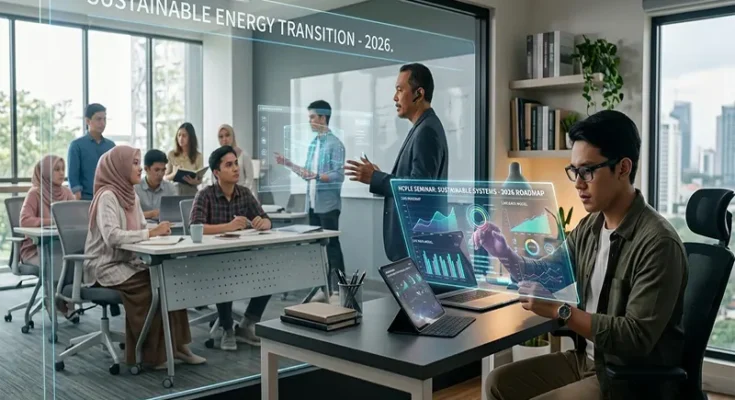
Hybrid Cyber-Physical Learning Environments for Remote Students 2026

Hybrid Cyber-Physical Learning Environments for Remote Students 2026

The era of the “Zoom Room” is officially over. As we navigate the educational landscape of March 2026, the passive, two-dimensional video call—once the lifeline of remote education—is now viewed as a primitive relic of the early 2020s. Today, the frontier of education is defined by Cyber-Physical Learning (CPL). This is not just “online school”; it is a sophisticated, bidirectional integration where digital interfaces and physical environments are seamlessly merged. For the remote student of 2026, learning is no longer something you watch; it is something you inhabit.

The Infrastructure of Presence: Beyond the Screen

The transition to CPL has been driven by a radical leap in hardware and network infrastructure. In 2026, “being there” is a quantifiable technical state achieved through three core technologies:

Digital Twins and Remote Lab-as-a-Service (RLaaS):

High-end universities now maintain 1:1 digital replicas of their physical laboratory equipment. A remote student in Indonesia can …

Hybrid Cyber-Physical Learning Environments for Remote Students 2026 Read More
Developing Human-Centered Power Skills in the AI Era

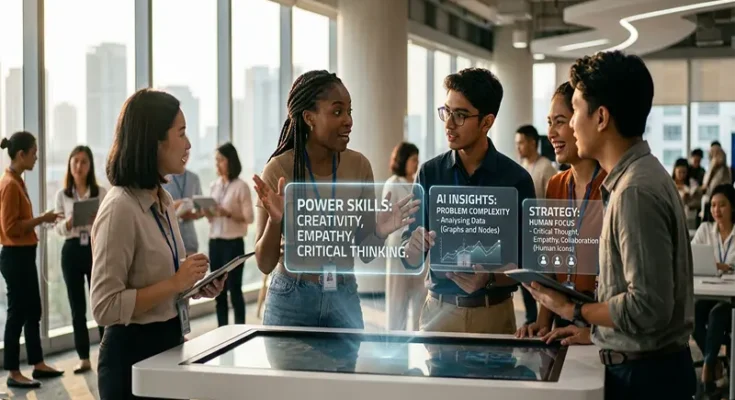
Developing Human-Centered Power Skills in the AI Era

In the early 2020s, the primary anxiety of the global workforce was technical obsolescence—the fear that AI would learn to code, write, and analyze faster than any human could. As we move through 2026, that fear has been replaced by a “Skills Paradox.” As Artificial Intelligence becomes more “human-like” in its output—generating flawlessly composed emails, sophisticated data models, and even realistic digital art—the most valuable assets in the labor market are no longer technical. Instead, the hard currency of the modern era is Power Skills: the deeply human, irreplaceable traits of empathy, ethical judgment, and strategic intuition.

The shift is clear: when the “How” of a task (execution) is commoditized by AI, the “Why” (intent) and the “Should” (ethics) become the ultimate differentiators of professional success.

The Four Pillars of Power Skills in 2026

To remain relevant in an AI-saturated economy, professionals must pivot away from tasks that rely …

Developing Human-Centered Power Skills in the AI Era Read More
Digital Transformation Strategies for Inclusive Higher Education 2026

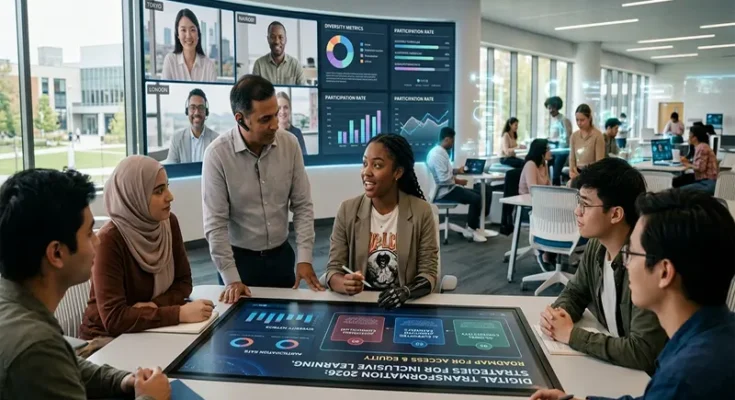
Digital Transformation Strategies for Inclusive Higher Education 2026

The definition of digital transformation in higher education has undergone a fundamental shift. In the early 2020s, the focus was primarily on “digitization”—moving analog processes online and adopting new technological tools. As we navigate the landscape of March 2026, the mandate has evolved from simple digitization to digital inclusion. For institutions of higher learning, true transformation is no longer just a technical upgrade; it is a profound cultural realignment, one that recognizes technology as the essential architecture for equity and access in a hybrid world.

This evolution is driven partly by urgency. Across the United States and Europe, new, stringent regulatory deadlines for web and mobile accessibility (such as the ADA and EN 301 549 updates) have come into force this Spring. However, beyond legal mandates, the 2026 landscape is defined by the “Stability Paradox”: the realization that foundational, stable IT systems—like Identity and Access Management (IAM) and robust …

Digital Transformation Strategies for Inclusive Higher Education 2026 Read More
Alternative Credentials and Micro-credentials for Career Advancement 2026

Alternative Credentials and Micro-credentials for Career Advancement 2026

The traditional career trajectory—a linear path fueled by a single four-year degree—is officially a relic of the past. As we move through 2026, the global workforce has pivoted toward a “Skills-First” economy. With the global alternative credentials market projected to reach $21.84 billion this year, the focus has shifted from where you studied to what you can execute right now. For professionals looking to stay competitive, micro-credentials, digital badges, and nano-degrees are no longer just “add-ons”; they are the primary language of career advancement.

The Skills-First Revolution: Why Degrees are No Longer Enough

In 2026, approximately 65% of employers have formally transitioned to skills-based hiring, effectively de-prioritizing the bachelor’s degree as a mandatory screening tool. This shift is driven by the sheer velocity of technological change; traditional academic curricula often take years to update, while a micro-credential can be developed and deployed in weeks to meet a specific market need.…

Alternative Credentials and Micro-credentials for Career Advancement 2026 Read More
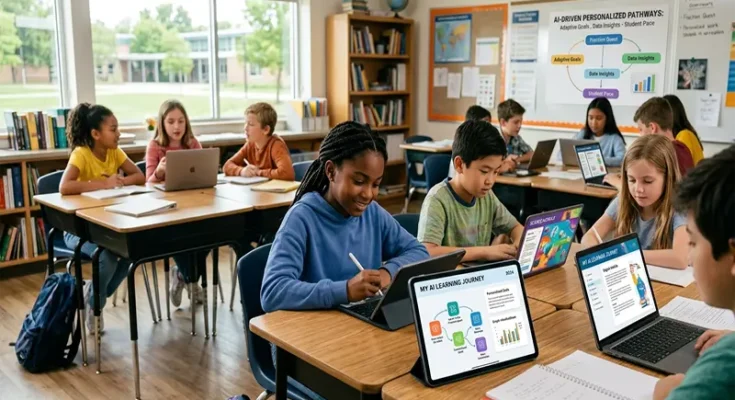
AI-Driven Personalized Learning Pathways for K-12 Students

AI-Driven Personalized Learning Pathways for K-12 Students

For decades, the “factory model” of education—characterized by a one-size-fits-all curriculum and synchronized pacing—has been the standard in K-12 classrooms. However, as we move through 2026, a fundamental shift is occurring. Artificial Intelligence (AI) is no longer a futuristic concept or a supplementary tool; it has become the architectural foundation for a new era of “one-size-fits-one” education. By leveraging AI-driven personalized learning pathways, schools are finally bridging the gap between theoretical pedagogy and the diverse, real-time needs of every student.

The Mechanics of Personalization: Beyond the Linear Curriculum

At its core, an AI-driven personalized learning pathway is a dynamic educational map that evolves as a student interacts with it. Unlike traditional digital textbooks that offer a linear progression, these systems utilize sophisticated machine learning algorithms and predictive analytics to analyze student behavior in real-time.

These platforms operate within what psychologists call the Zone of Proximal Development (ZPD)—the “sweet spot” …

AI-Driven Personalized Learning Pathways for K-12 Students Read More