
The “Reading Wars” that defined much of the early 21st century have largely concluded. As of March 2026, the global educational landscape has reached a decisive consensus: the Science of Reading is the definitive framework for literacy instruction. For the 20% of the population living with dyslexia, this shift from “balanced literacy” to Structured Literacy is more than a pedagogical trend—it is a neurological necessity. New research released this year continues to underscore that dyslexia is not a reflection of intelligence but a neurobiological condition affecting phonological processing. By implementing evidence-based interventions early and systematically, we are now seeing classrooms where the “reading gap” is no longer an inevitability.
The 2026 Breakthrough: Dyslexia as a “Network Vulnerability”
Groundbreaking research from the University of Houston in early 2026 has reframed our understanding of the dyslexic brain. Moving away from the hunt for a single “faulty gene,” scientists now view dyslexia as an overall brain network vulnerability. This study identified two distinct developmental origins for reading struggles: one related to the brain’s physical wiring during fetal development, and another related to how neurons signal each other later in development.
Furthermore, a 2026 Stanford-led study utilized functional MRI to prove that the Visual Word Form Area (VWFA)—the brain’s “letterbox”—is highly plastic. The study showed that after just eight weeks of intensive, evidence-based intervention, the VWFA actually grew larger in children with dyslexia. This confirms what educators have long suspected: the right instruction doesn’t just teach a child to read; it literally rewires the brain.
The 5 Pillars of Structured Literacy
In the 2026 classroom, effective intervention is built on five non-negotiable pillars. These must be taught explicitly (nothing is left to chance) and systematically (moving from simple to complex).
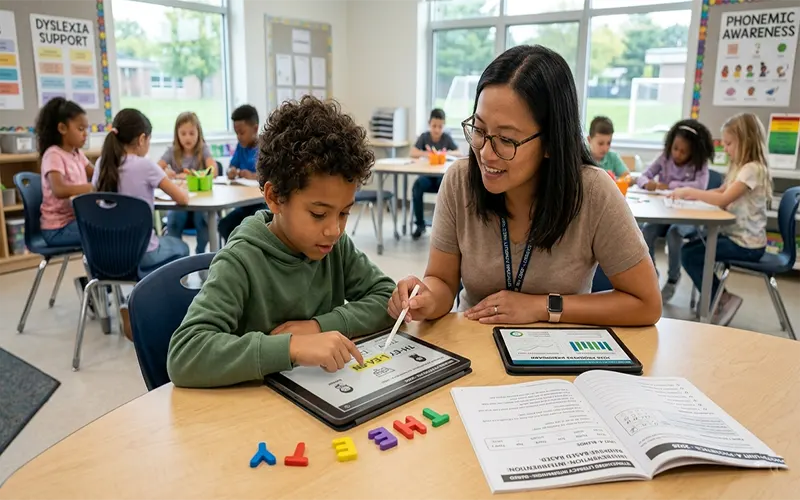
- Phonemic Awareness: This is the ability to hear and manipulate individual sounds (phonemes) in spoken words. In 2026, the focus has shifted toward “advanced phonemic awareness,” where students practice deleting or substituting sounds (e.g., “Say blast. Now say blast without the /l/”) to build the mental agility required for rapid decoding.
- Phonics & Orthography: Students are taught the 44 speech sounds of English and the 250+ ways to spell them. The “Six Syllable Types” (Closed, Open, Magic E, Vowel Team, R-Controlled, and Consonant-le) provide students with a logical “code” to unlock multisyllabic words.
- Fluency: Fluency is the bridge to comprehension. It is no longer measured by speed alone, but by prosody (expression) and accuracy. 2026 interventions emphasize “Guided Oral Reading” and “Repeated Reading,” where students receive immediate, corrective feedback.
- Vocabulary & Morphology: For dyslexic learners, understanding the “meaning units” of language—morphemes—is a game-changer. By teaching Greek and Latin roots, prefixes, and suffixes, educators give students the tools to decode complex academic language by identifying familiar “chunks” (e.g., bio- + graph + -y).
- Comprehension: While decoding is the “how,” comprehension is the “why.” 2026 models move away from simple “guessing” strategies and instead use graphic organizers and mental modeling to help students visualize and synthesize information.
Top Evidence-Based Programs for 2026
The market for dyslexia intervention has matured into a few high-quality, research-aligned options that dominate the 2026 educational space:
| Program | Core Methodology | Best For |
| Orton-Gillingham (OG) | Multi-sensory, diagnostic, and prescriptive. | Individualized 1:1 or small group intensive tutoring. |
| Wilson Reading System | Structured Synthetic Phonics (SSP) with a focus on encoding. | Students in Grade 2+ requiring highly cumulative instruction. |
| Lexia PowerUp | AI-driven adaptive literacy software. | Providing high-frequency practice and data-driven teacher alerts. |
| Nessy Reading & Spelling | Highly gamified, multi-sensory digital platform. | Early intervention (ages 6–11) to maintain high engagement. |
While Orton-Gillingham remains the “gold standard” for its diagnostic nature, digital tools like Nessy and Lexia are increasingly used to provide the “intensity” of practice required for neural change.
Technology as an Accelerator: AI and Eye-Tracking
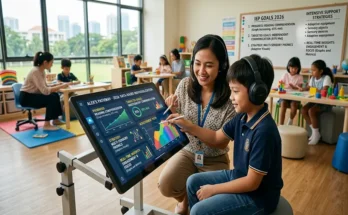
The most significant technological leap in 2026 is the mainstreaming of AI-driven screening. New tools using webcam-based eye-tracking and automated speech assessment can now identify kindergarteners at risk for dyslexia with over 90% accuracy. These systems analyze fixation durations (how long a child looks at a word) and regressions (how often they look back), catching subtle markers long before a student experiences the “failure” associated with 3rd-grade reading.
The Emotional Landscape: Breaking the Matthew Effect
The 2026 focus isn’t just on the mechanics of reading, but on the psychological toll of the Matthew Effect—the “rich-get-richer and poor-get-poorer” phenomenon in literacy. When a child struggles to decode, they read less. Because they read less, they gain less vocabulary and background knowledge, causing the gap between them and their peers to widen exponentially over time.
To combat this, 2026 interventions adopt a “Strengths-Based” model. This approach recognizes that while the dyslexic brain struggles with phonology, it often excels in “big picture” thinking, pattern recognition, and creativity. By celebrating these “Sea of Strengths” while providing the structural support for the “island of weakness,” schools are fostering resilience and preventing the self-esteem crises common in previous decades.
The Call for Universal Early Intervention
The evidence in 2026 is undeniable: early intervention is the most effective way to change a child’s academic trajectory. By combining high-touch Structured Literacy with high-tech AI screening, we have the tools to ensure that dyslexia is a manageable difference rather than a lifelong disability. The goal for every district is now universal screening by the end of Kindergarten, ensuring that no child has to “fail” before they are given the help they need to thrive.