
For special education teachers, the Individualized Education Program (IEP) is both a lifeline for students and a mountain of paperwork. Historically, tracking progress toward measurable goals meant a fragmented system of “binders and sticky notes,” where raw data often sat for weeks before being manually graphed into a progress report. As we navigate 2026, the “administrative burden” of special education is being radically reshaped. AI-powered tools are no longer just drafting tools; they are sophisticated data-synthesis engines that ensure every student’s growth is documented with precision and legal compliance.
The Landscape of 2026: Top AI Tools for IEP Management
The current market has moved away from general-purpose AI toward “fit-for-purpose” agents designed specifically for the legal and instructional complexities of the Individuals with Disabilities Education Act (IDEA). Below are four leading tools currently transforming special education workflows.
| Tool | Primary Strength | Best For |
| AbleSpace | Mobile-first data collection & automated graphing | Real-time tracking of behavioral and academic probes. |
| MagicSchool AI | Comprehensive SpEd-specific suite | Drafting IEP sections, BIPs, and “Support Goal” generation. |
| Playground IEP | 50-State standards integration | Aligning goals with specific state benchmarks and compliance. |
| Brisk Teaching | Integrated Chrome Extension | Generating goal plans and feedback within Google Docs or an LMS. |
AbleSpace has gained significant traction for its “graph-as-you-go” functionality. Teachers can input a single data probe during a lesson, and the system instantly updates a visual trend line. Meanwhile, MagicSchool AI remains a favorite for its “IEP Generator,” which helps educators synthesize classroom observations into a professional, cohesive narrative.
The Anatomy of a Measurable AI-Generated Goal
A persistent challenge in special education is moving from vague aspirations to “SMART” (Specific, Measurable, Attainable, Relevant, Time-bound) goals. AI has proven particularly effective at this refinement process.
Consider a common “weak” goal: “The student will improve their reading fluency during the 2026 school year.” This lacks a baseline, a specific metric, and a clear condition.
When processed through an AI goal-refinement tool, the output becomes:
“Given a second-grade level reading passage, Marcus will read 65 words correct per minute (WCPM) with 95% accuracy over three consecutive trials, as measured by bi-weekly teacher-conducted fluency probes by June 2026.”
By analyzing the student’s Present Levels of Academic and Functional Performance (PLAAFP), AI tools can suggest the exact percentages and trial counts that represent meaningful growth, ensuring the goal is legally defensible and instructionally useful.
Turning Raw Data into Visual Progress
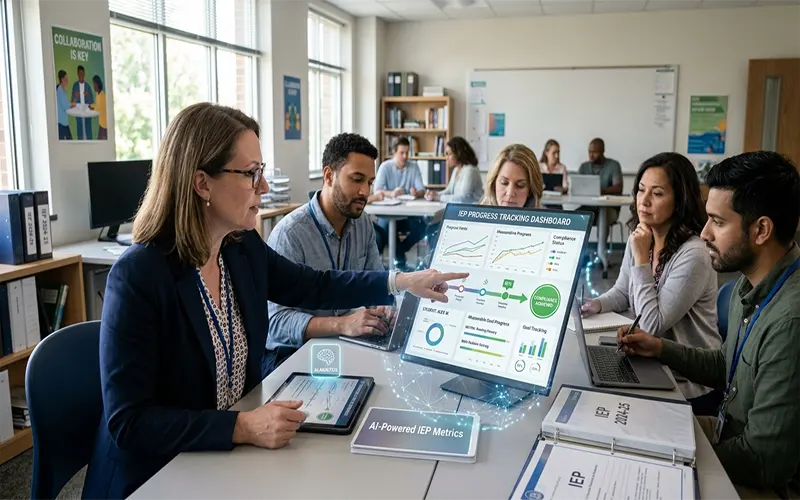
Perhaps the greatest relief for educators is the automation of data visualization. In a traditional setting, a teacher might have 20 data points for a single social-emotional goal. At the end of the quarter, they must manually calculate averages and draw charts for the IEP team.
Modern AI tools allow teachers to:
- Digitize Analog Data: Use a tablet or phone to capture photos of handwritten tally sheets, which the AI then converts into digital data points.
- Instant Graphing: Generate bar charts, line graphs, and scatter plots that highlight “aim lines” versus “actual performance.”
- Predictive Alerts: Some 2026 platforms now include “stagnation alerts.” If a student’s data shows four consecutive points below the aim line, the AI flags the teacher, suggesting that it may be time to adjust the intervention before the student falls too far behind.
Security & Ethics: The Non-Negotiables
As these tools become integrated into school districts, the ethical guardrails have become more stringent. It is a “non-negotiable” rule that no personally identifiable information (PII) should ever be entered into a general, non-secure AI.
- FERPA & HIPAA Compliance: Districts are now prioritizing “closed-loop” systems. Unlike public AI models that “learn” from your data, district-approved tools like PowerBuddy for Special Programs or Playground IEP ensure that data is encrypted and remains within the school’s secure network.
- The “Human-in-the-Loop” Necessity: AI is a co-pilot, not the captain. Every AI-generated draft must be reviewed by a licensed special educator. AI can suggest a goal based on data, but it cannot account for the nuanced emotional or environmental factors that only a teacher who knows the student can provide.
Reclaiming the Heart of Teaching
The ultimate value of AI in tracking IEP goals is not just about compliance; it is about time. When a teacher saves five to ten hours a week on data entry and report writing, that time is reinvested into direct instruction and one-on-one student support.
By shifting the focus from “paperwork” to “progress,” AI-powered tools are helping special educators return to the work that matters most: helping every student, regardless of their starting point, reach their full potential.