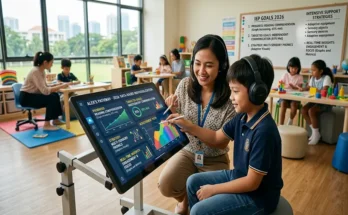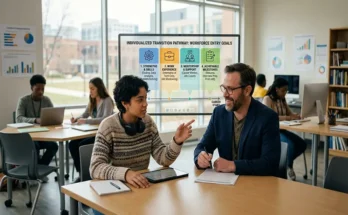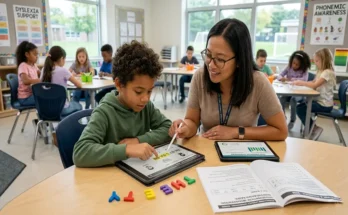
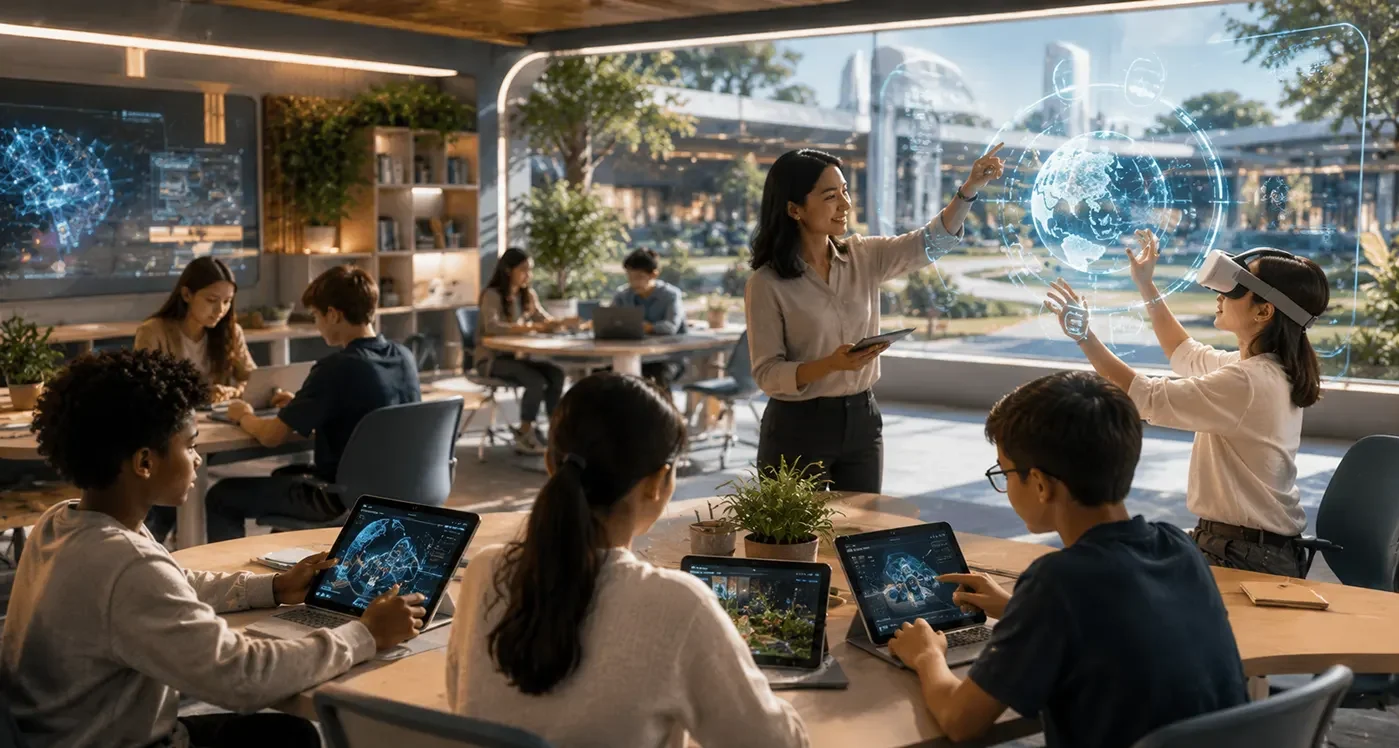
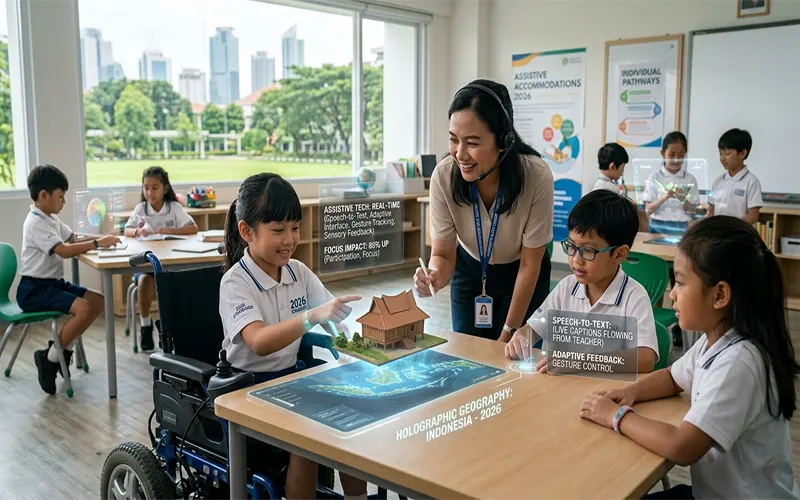
The defining educational shift of the mid-2020s has been the transformation of the General Education classroom into a truly inclusive, neuro-affirming space. As of March 2026, the artificial divide between “specialized” technology for students with disabilities and “standard” technology for everyone else has largely dissolved. We are now witnessing the maturity of Universal Design for Learning (UDL), facilitated by an integrated suite of Assistive Technology (AT). What was once viewed as an “accommodation” for a few is now recognized as a vital, flexible interface for all learners. This phenomenon, known as the “curb-cut effect” in education, acknowledges that tools designed for specific accessibility challenges ultimately improve usability for the entire classroom population.
The 2026 AT Toolkit: Access by Default
The modern AT toolkit in a general education setting is no longer defined by bulky, stigmatizing hardware. Instead, it is characterized by software integration, cloud-based personalization, and AI-powered real-time support. These accommodations fall into several functional categories that support the diverse cognitive and physical needs of a 2026 classroom.
1. Reading & Literacy: The Auditory Text
For students with dyslexia, visual impairments, or English Language Learning (ELL) needs, decoding text is no longer a barrier to accessing content. AI-Powered Text-to-Speech (TTS) has moved beyond robotic monologues to feature natural, synthesized voices that convey tone and emotion. Students in 2026 rarely ask for a “reader”; they simply toggle the “Speak” function on their digital textbook. Furthermore, near-instant Optical Character Recognition (OCR) allows students to use a tablet camera to scan a physical worksheet or museum plaque and immediately convert it into accessible digital text for listening or resizing.
2. Writing & Expression: Thought-to-Text
The labor of handwriting or typing can be a significant bottleneck for students with dysgraphia, fine motor challenges, or executive functioning issues. Speech-to-Text (STT), or dictation, has achieved near-perfect accuracy in 2026, even in noisy classrooms. Students are coached to compose outlines and drafts using their voice, bypassing mechanical barriers. Additionally, AI-driven Word Prediction and Sentence Starters provide a “scaffold” for students struggling with initiation, allowing them to focus on the content of their ideas rather than the mechanics of spelling and grammar.
3. Executive Functioning: The Cognitive Coach
The complexity of the 2026 hybrid curriculum requires strong organizational skills. Digital Visual Timers and smart-task lists that automatically “gamify” completion help students with ADHD and executive dysfunction stay on task. Most browser and OS environments now feature a “Focus-Mode” extension that acts as a cognitive filter, stripping away ads, sidebars, and autoplay videos from a research article, instantly reducing the cognitive load.
4. Sensory & Physical Access: Plug-and-Play Inclusion
Classroom acoustic environments have been revolutionized by Digital Soundfield Systems (often called FM or DM systems). The teacher wears a subtle microphone, and their voice is evenly distributed through discreet, flat-panel speakers throughout the room, benefiting students with hearing impairments, auditory processing disorders, and general attention challenges. For students with complex physical disabilities, alternative input devices—such as switch access and High-Fidelity Eye-Tracking—are now standard “plug-and-play” peripherals, requiring zero specialized IT support to connect to a classroom laptop.
The Shift to Multi-Modal “Living Documents”
In 2026, the standard textbook is dead. It has been replaced by the “Living Document.” Curricula are designed from the ground up to be multi-modal. A student studying the cell cycle can choose to read the text, listen to a synchronized audio version, watch an embedded 3D AR simulation, or complete an interactive puzzle on the same digital page. Students are empowered to “Bring Your Own Accommodation” (BYOA), as their personalized accessibility profile syncs automatically with whatever device they are using, ensuring their preferred fonts, color contrasts, and support tools are always available.
AI as a Real-Time Scaffolder
The most transformative AT advancement of 2026 is the use of AI Leveling Tools. A general education teacher no longer needs to find three different articles on photosynthesis to match the reading levels of their diverse class. They can take a single, complex grade-level text and, with one click, use AI to generate copies at multiple “Lexile” (reading complexity) levels, complete with vocabulary definitions and summary bullets. This allows every student to engage with the same core curriculum and academic discussion, regardless of their decoding or comprehension speed.
Implementation Strategies for the Modern Teacher
The success of AT in 2026 hinges on effective classroom orchestration. Educators are trained in “Low-Friction Integration.” This requires moving away from the “lab model” and toward “just-in-time” support. Teachers design lessons with AT built-in: “For this pre-writing activity, you may type, write, or use dictation.”
Managing a classroom where 25 students might be using 25 different digital accommodations simultaneously requires a shift from policing device use to coaching tool selection. Teachers view themselves as “learning engineers,” helping students identify which specific tool helps them overcome a specific learning hurdle in that moment.
Privacy, Equity, and the “Silicon Divide”
The high-tech reality of 2026 raises significant ethical questions. As student learning profiles become more data-rich, strict Data Sovereignty and privacy protocols are essential. Schools must ensure that biometric and usage data from assistive tools is owned by the student and family, not the EdTech provider.
Furthermore, we must guard against a new “Silicon Divide,” where high-quality AI scaffolding and haptic AT are available only in well-funded districts. True inclusion demands that these robust AT accommodations are viewed as basic educational infrastructure, guaranteed for all students regardless of zip code.
The Invisible Accommodation
By 2026, the goal of Assistive Technology is simple: to become invisible. When a student adjusts the font size on their screen, uses their voice to draft an essay, or listens to an AR overlay of a diagram, they are not using a “special education tool.” They are simply engaging with the human-learning interface. The stigmatization of AT has eroded because the tools are ubiquitous, intuitive, and effective for everyone. The standard for inclusion is no longer just presence; it is accessible, multi-modal contribution.
High-Tech vs. Low-Tech AT Comparison Table
| Learning Goal | Low-Tech Solution (Evergreen) | 2026 High-Tech Solution (Integrated) |
| Reading | Colored Overlays / Large Print | AI-Synthesized Natural Speech / Leveling Tools |
| Writing | Pencil Grips / Slant Boards | Haptic Hacking / Thought-to-Text / Eye-Tracking |
| Organization | Paper Planners / Visual Schedules | AI Executive Functioning Coaches / Smart Timers |
| Math | Manipulatives (Blocks/Counters) | Interactive AR 3D Simulations / Desmos Graphing |
| Focus | Fidgets / Weighted Vests | Biometric Feedback Wearables / “Focus-Mode” OS |