The era of the “Zoom Room” is officially over. As we navigate the educational landscape of March 2026, the passive, two-dimensional video call—once the lifeline of remote education—is now viewed as a primitive relic of the early 2020s. Today, the frontier of education is defined by Cyber-Physical Learning (CPL). This is not just “online school”; it is a sophisticated, bidirectional integration where digital interfaces and physical environments are seamlessly merged. For the remote student of 2026, learning is no longer something you watch; it is something you inhabit.
The Infrastructure of Presence: Beyond the Screen
The transition to CPL has been driven by a radical leap in hardware and network infrastructure. In 2026, “being there” is a quantifiable technical state achieved through three core technologies:
Digital Twins and Remote Lab-as-a-Service (RLaaS):
High-end universities now maintain 1:1 digital replicas of their physical laboratory equipment. A remote student in Indonesia can open a digital interface that mirrors a high-powered electron microscope located in London. When the student adjusts a knob on their digital twin, a robotic actuator on the physical device moves with sub-millimeter precision. This “Remote Lab-as-a-Service” model ensures that specialized scientific equipment is no longer bound by geography.
Spatial Computing and Volumetric Avatars:
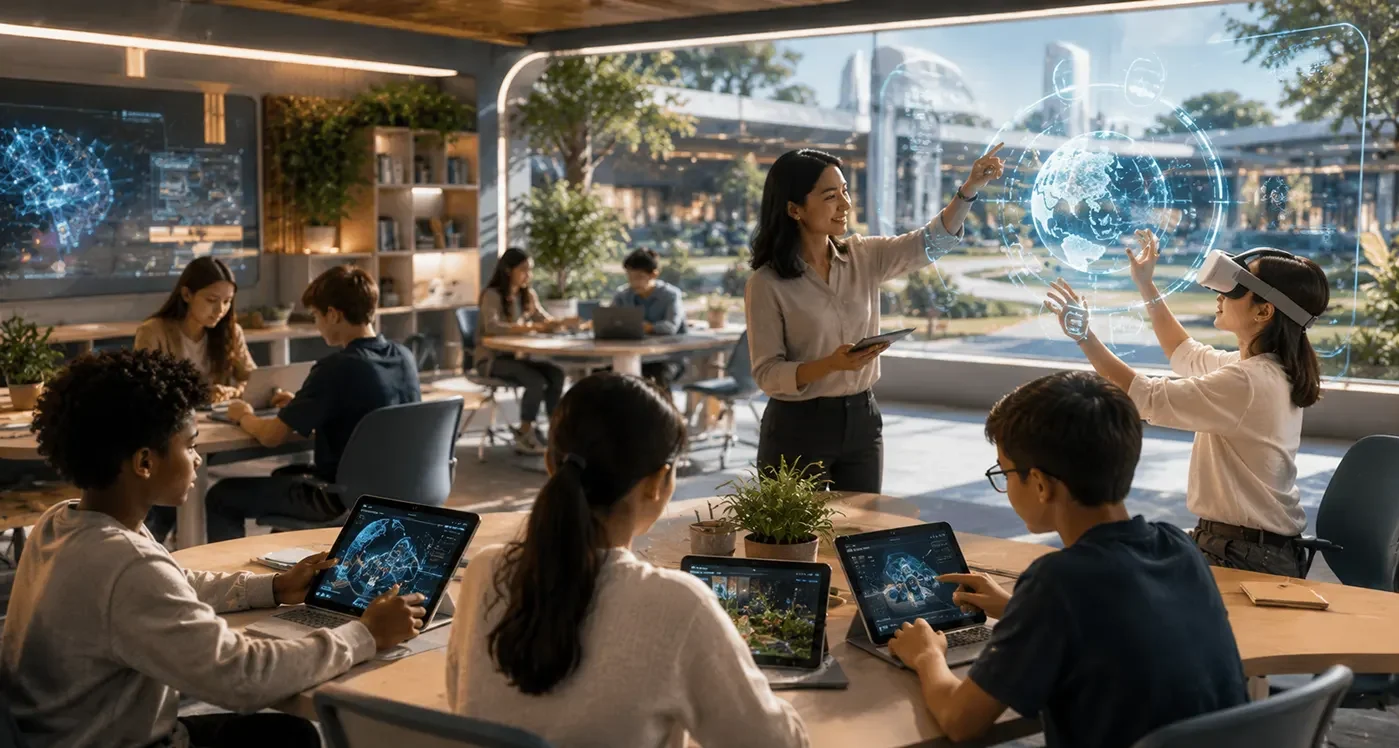
Using the latest generation of spatial headsets, remote students are no longer “tiles” on a screen. They are projected into the physical classroom as volumetric 3D avatars. To the local students and the professor, the remote student appears to occupy a specific physical space in the room. This restores the non-verbal cues—eye contact, pointing, and spatial orientation—that were lost in the flat-screen era.
Haptic Feedback and Tactile Telepresence:
2026 wearables have introduced the “sense of touch” to remote learning. Haptic gloves allow an engineering student to “feel” the resistance of a virtual torque wrench or the texture of a 3D-scanned archaeological artifact. This sensory feedback is critical for developing the muscle memory required in vocational and technical fields.
The “Phygital” Classroom: A Day in the Life
Consider a chemistry student living in a rural mountainous region. In a legacy system, they would watch a video of an experiment. In a 2026 Hybrid Cyber-Physical Environment, they don their headset and “step into” the university’s urban lab.
The student stands at a physical “haptic bench” in their home. On this bench, they see a digital twin of a centrifuge. To their left, a volumetric avatar of a local lab partner appears. They can collaborate in real-time to mix reagents—the remote student’s movements are mirrored by a desktop-sized robotic arm in the physical lab, while the local student handles the physical glassware. The data from the physical sensors (temperature, pH levels, reaction speed) is fed back to the remote student’s interface with less than 20ms of latency, creating a shared reality that is “phygital”—simultaneously physical and digital.
AI as the Environment Manager: Optimizing the “Latency of Learning”
The invisible hero of CPL is Artificial Intelligence. In 2026, AI serves as the “Traffic Controller” for immersive data. High-fidelity spatial environments require massive bandwidth; AI optimizes this by using Predictive Rendering.
The AI analyzes a student’s head and hand movements to predict where they will look next, pre-rendering those segments of the cyber-physical environment. This ensures that the “latency of learning” stays below the threshold of human perception, preventing motion sickness and maintaining the “illusion of presence.” Furthermore, AI monitors the “synchronicity” of the lab, ensuring that if a remote student triggers a physical event, the feedback is perfectly timed across all participants’ devices, regardless of their global location.
Equity and the “Silicon Divide”
While CPL offers unprecedented access, it also risks creating a new “Silicon Divide.” These environments are data-hungry, traditionally requiring fiber-optic speeds. To combat this, 2026 strategies focus on Edge Computing.
By placing localized servers at the “edge” of rural networks, institutions can process heavy spatial data closer to the student, reducing the need for a massive “pipe” back to the central university. Additionally, “asynchronous CPL” allows students with lower bandwidth to download the digital twin assets overnight and sync only the critical “interaction packets” during the live session. Ensuring that inclusive higher education includes those in low-bandwidth areas remains the primary ethical challenge of the current year.
The Pedagogical Shift: From Content to Experience
For educators, the shift to CPL requires a total redesign of the “Lesson Plan.” We are moving from Content Delivery to Experiential Engineering.
A teacher in 2026 does not just prepare a lecture; they design a “Space.” They must consider how a concept will be visualized in 3D, how a remote student will interact with physical objects, and how to facilitate group work between local and volumetric participants. Pedagogy is now about creating “Active Inquiry” loops where the student’s physical actions—whether in a home office or a campus lab—drive the digital learning outcome.
The Borderless Campus
As we look toward the 2030s, the concept of a “campus” is being entirely redefined. The physical walls of the university have become permeable. A “Hybrid Cyber-Physical Environment” is not a compromise for those who cannot travel; it is a superior, high-data immersion that offers more flexibility and precision than traditional models.
In 2026, the borderless campus is a reality. We have successfully moved from a world where you “go to school” to a world where “the school comes to you,” in full, haptic, 3D glory.
Cyber-Physical Integration Level Table
| Level | Name | Interaction Type | Primary Hardware |
| Level 1 | Digital Observational | Passive 2D Video/Audio | Laptop/Webcam |
| Level 2 | Interactive Simulation | 2D/3D non-haptic control | PC + Mouse/Controller |
| Level 3 | Spatial Presence | Volumetric Avatars/AR | VR/AR Headset |
| Level 4 | Cyber-Physical | Digital Twin + Haptic Feedback | Headset + Haptic Wearables |
| Level 5 | Full Telepresence | Bidirectional Robotics & Sensory Sync | Robotics + Edge Computing |