
In the landscape of 2026, special education has moved beyond the era of “wait and see.” For students with the most complex learning and behavioral needs, the margin for instructional error is virtually non-existent. Traditional Individualized Education Programs (IEPs) that rely on quarterly or annual reviews are increasingly viewed as insufficient for students requiring intensive support. The current gold standard is Data-Based Individualization (DBI)—a research-driven, high-frequency framework that treats instruction with the precision of clinical medicine. By synthesizing multi-dimensional data streams, educators can now make micro-iterative adjustments to a student’s “instructional dosage” every two to three weeks, ensuring that no student languishes in an ineffective intervention.
The 5-Step DBI Process: A Cycle of Precision
DBI is not a single “product” but a rigorous, evidence-based process for intensifying instruction. In 2026, this cycle is powered by real-time analytics and a “Human-in-the-Loop” (HITL) philosophy.
1. Validated Intervention Program:
The process begins with a research-based “base” program. Before individualizing, the educator ensures the core intervention has a high probability of success for the student’s specific disability profile. In 2026, these programs are often “modular,” allowing for specific components (like phonemic awareness or functional communication) to be swapped based on early data.
2. Progress Monitoring:
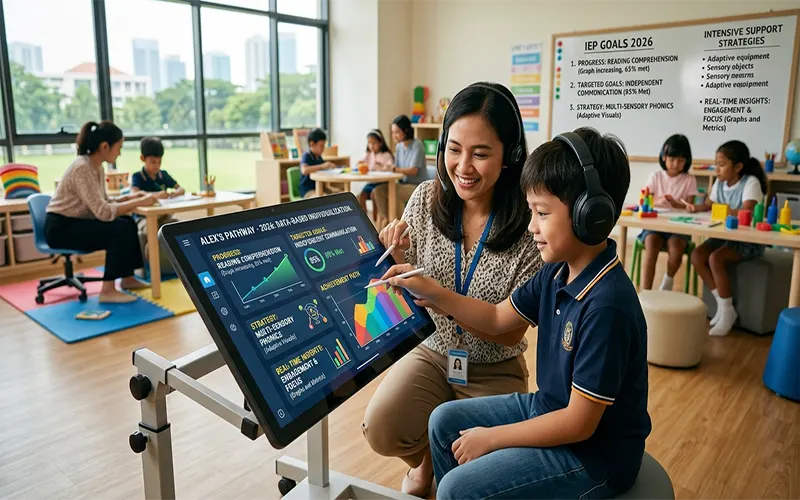
Instruction is only as good as the data that tracks it. Intensive special education now utilizes high-frequency probes—often daily or bi-weekly—to measure a student’s “slope of improvement.” We no longer look at just “percentage correct”; we look at fluency (accuracy plus speed), often mapped on a Standard Celeration Chart to visualize the rate of learning over time.
3. Clinical Sensitivity & Diagnostic Data:
When a student is “non-responsive” (their data trend is flat or declining), the DBI process triggers a diagnostic phase. Educators perform a deep-dive error analysis: Is the student failing because of a lack of prerequisite skills, an executive functioning bottleneck, or a sensory regulation issue? This is where “clinical sensitivity” meets data science.
4. Adaptation of Instruction:
Based on the diagnostic data, a specific change is made. This is the “Individualization” in DBI. Adaptations usually fall into three categories:
- Dosage: Increasing the frequency or duration of the intervention.
- Alignment: Adjusting the content to better match the student’s specific cognitive profile.
- Focus: Shifting from broad skills to “micro-skills” (e.g., moving from “reading words” to “blending three specific phonemes”).
5. Continued Progress Monitoring:
Once the adaptation is implemented, the cycle restarts. The team monitors the “re-intensity” of the intervention to see if the slope of the student’s learning line has shifted upward.
Advanced Data Streams in 2026: Multidimensional Profiles
The most significant shift this year is the integration of diverse data streams that go beyond traditional paper-and-pencil tally marks.
- Biometric Engagement Data: Many students in intensive programs now utilize non-invasive wearables that track physiological markers like heart rate variability (HRV) and skin conductance. These provide an “early warning system” for frustration or sensory overload, allowing educators to intervene before a behavioral crisis occurs.
- Automated Speech Analysis: For non-speaking or minimally verbal students, AI-powered microphones in the classroom can track vocal approximations and communication attempts. This data helps Speech-Language Pathologists (SLPs) identify emerging patterns in “Functional Communication Training” that might be missed by the human ear.
- Predictive Trend Lines: Modern dashboards use machine learning to predict a student’s “rate of mastery” with 90% accuracy. If the AI predicts that a student will not meet their goal by June based on current progress, it flags the IEP team for an emergency DBI meeting in March.
Visual Analysis and the “Three-Point Rule”
In 2026, the interpretation of data is as standardized as the collection. Educators are trained in visual analysis, focusing on three specific markers: Level (the student’s current performance), Trend (the direction of growth), and Variability (how much the scores bounce around).
The “Three-Point Rule” has become the industry standard for making instructional changes. If three consecutive data points fall below the “aim line” (the path required to reach the goal), the educator must make an instructional adaptation. This prevents the “wait and see” trap and ensures that time—the most precious resource in special education—is never wasted.
Collaborative Data Triangulation: The Whole-Child Dashboard
Data is no longer siloed. In a “Whole-Child” data meeting, teachers, Occupational Therapists (OT), Physical Therapists (PT), and parents review a unified digital dashboard. A drop in a student’s reading data might be triangulated with a change in their medication (provided by parents) or a decrease in their fine-motor stamina (observed by the OT). This holistic view ensures that adaptations are made to the student’s environment, not just their curriculum.
Ethical Data Management and the Human Touch
With the rise of high-tech data, the “Human-in-the-Loop” requirement is more critical than ever. We must ensure that a student is never reduced to a “data point.” Data is used to inform instruction, not to dehumanize the student’s unique personality or preferences. Ethics in 2026 also involves strict “Data Minimization”—only collecting what is necessary for instructional growth—and ensuring that biometric data is encrypted and deleted once it has served its educational purpose.
From Intensive Work to Smarter Work
The future of intensive special education lies in Precision Teaching. By shifting the focus from “trying harder” to “adjusting specifically,” DBI allows educators to meet the unique neurological needs of every student. In 2026, “intensive” does not mean a teacher working harder in a vacuum; it means a team working smarter through the power of data. When we move from guessing to knowing, we move from providing an education to providing a future.