
The transition from the structured, highly accommodated environment of K–12 education to the autonomous world of employment is often described as a “cliff” for neurodivergent students. Whether a student is autistic, has ADHD, dyslexia, or executive functioning challenges, the leap requires more than just job skills; it requires a specialized set of “transition goals” that bridge the gap between potential and professional success.
As of March 2026, the corporate landscape has shifted significantly. With nearly 85% of Fortune 500 companies now boasting dedicated neuro-inclusion programs, the focus is no longer on “fixing” the student to fit a rigid mold. Instead, modern transition planning is about identifying the “Right Fit” environment and equipping the student with the self-advocacy and technological tools to thrive within it.
The Foundation: Self-Advocacy and Disclosure Mastery
The most critical goal in any transition plan is the mastery of self-advocacy. In the workplace, accommodations are not automatically granted as they are under an IEP; they must be requested.
Goal: The student will independently describe their “operating system”—their specific strengths and environmental needs—to an employer or supervisor.
In 2026, “Disclosure Mastery” does not necessarily mean sharing a medical diagnosis. Instead, students are coached to use functional language. For example, rather than saying “I have ADHD,” a student might say, “I am most productive when I can use written checklists for multi-step tasks and work in a quiet space for deep-focus projects.” Transition planning must include role-playing the “Disclosure Decision”: determining when to disclose (during the interview, after the offer, or when a challenge arises) and identifying which accommodations are “reasonable” under the updated 2026 ADA guidelines.
Executive Functioning: Systems Over Memory
Executive functioning—the brain’s “air traffic control” system—is often the primary barrier to workplace retention for neurodivergent professionals. Transition goals must move away from “reminding the student” toward “the student using a system.”
Goal: The student will utilize a digital task-management system to break down a project into micro-steps and meet 90% of internal deadlines.
Key areas of focus for 2026 include:
- Time Management: Shifting from “internal sense of time” to externalized prompts. Students should master tools like digital calendars with auditory alerts and “time-blocking” techniques.
- Task Initiation: Using “Work-Start” rituals or AI-driven prompts to overcome the paralysis that often accompanies complex or ambiguous assignments.
- Sensory Regulation: A student should be able to identify their sensory triggers—such as fluorescent lighting or open-office chatter—and proactively request environmental tweaks, such as noise-canceling headphones or a desk in a low-traffic area.
Social Communication and the “Hidden Rules” of 2026
The modern workplace is increasingly hybrid, introducing new “hidden rules” of social communication. Transition goals must address the nuances of digital etiquette on platforms like Slack, Zoom, and Microsoft Teams.
Goal: The student will demonstrate professional digital communication by responding to peer inquiries within an established timeframe and using appropriate tone/context for the platform.
Neurodivergent students often struggle with “non-literal” instructions. A goal should include practicing “Clarification Loops”—the ability to say, “I want to make sure I understood your expectations; are you looking for a brief summary or a detailed report by Friday?” This reduces the anxiety of “mind-reading” a manager’s intent and ensures alignment on deliverables.
Technology as a Cognitive Prosthetic
In 2026, technology is the great equalizer. Transition planning should integrate specific “Cognitive Prosthetics” that bypass a student’s areas of challenge.
- AI Writing Assistants: For students with dyslexia or dysgraphia, using generative AI to draft professional emails or summarize long meeting transcripts is a vital workplace skill.
- Speech-to-Text (STT): For those who process better verbally, mastering STT allows them to output high-quality reports without the bottleneck of typing.
- Wearable Stress Monitoring: Many neurodivergent professionals now use wearables that monitor heart rate variability (HRV). A transition goal might involve the student learning to recognize a “stress spike” on their device and independently taking a five-minute sensory break to prevent burnout.
Work-Based Learning: The “Proof of Work” Portfolio
The traditional 30-minute interview is often the hardest hurdle for neurodivergent candidates. Transition planning in 2026 emphasizes “Work-Based Learning” over traditional interviewing.
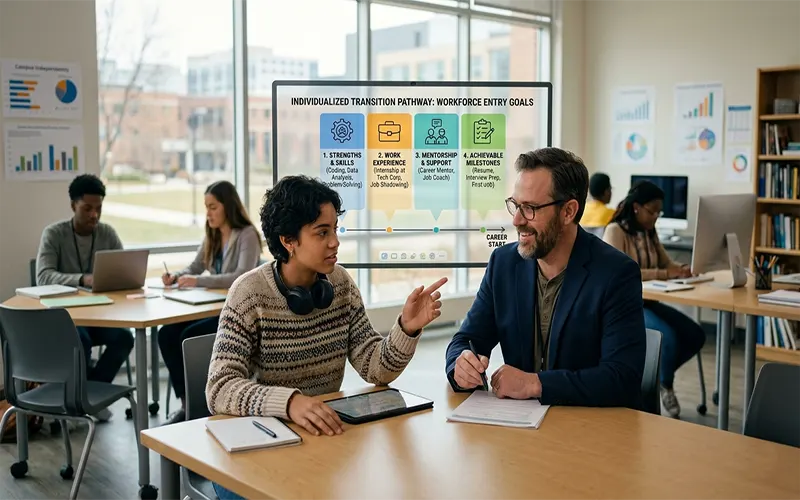
Goal: The student will complete at least two micro-internships or job-shadowing experiences and compile a “Professional Portfolio” showcasing tangible projects.
By showing a GitHub repository, a graphic design portfolio, or a successfully completed data entry project, the student provides “Proof of Work.” This allows the employer to evaluate the student’s actual output rather than their ability to maintain eye contact or engage in small talk during an interview.
From Compliance to Contribution
The ultimate objective of transition planning is to move the student from a state of “compliance” (doing what they are told) to “contribution” (adding value through their unique perspective). When we stop trying to “cure” neurodivergence and start planning for it as a structural reality, we open the door to a workforce that is not only more inclusive but more innovative. The “cliff” of adulthood becomes a bridge to a career where the student’s “operating system” is seen not as a bug, but as a feature.
Transition Readiness Rubric
| Skill Area | Emerging (Requires Support) | Proficient (With Prompts) | Independent (Self-Managed) |
| Self-Advocacy | Knows they have a challenge but cannot name it. | Can name the challenge but needs help asking for help. | Can describe needs and request specific accommodations. |
| Time Management | Relies on others for reminders/deadlines. | Uses a calendar when prompted by a coach/parent. | Independently manages a digital calendar and alerts. |
| Communication | Struggles with professional tone or “hidden rules.” | Can follow a template for professional emails. | Navigates hybrid communication (Slack/Zoom) fluently. |
| Technology Use | Uses tech for entertainment only. | Uses specific tools (AI/STT) with guided instruction. | Proactively selects the best tool for the task at hand. |